

- English
 简体中文
 Español
 Português
 русский
 Français
 日本語
 Deutsch
 tiếng Việt
 Italiano
 Nederlands
 ภาษาไทย
 Polski
 한국어
 Svenska
 magyar
 Malay
 বাংলা ভাষার
 Dansk
 Suomi
 हिन्दी
 Pilipino
 Türkçe
 Gaeilge
 العربية
 Indonesia
 Norsk
 تمل
 český
 ελληνικά
 український
 Javanese
 فارسی
 தமிழ்
 తెలుగు
 नेपाली
 Burmese
 български
 ລາວ
 Latine
 Қазақша
 Euskal
 Azərbaycan
 Slovenský jazyk
 Македонски
 Lietuvos
 Eesti Keel
 Română
 Slovenski
 मराठी

The Story of Shipping Container
The emergence of containers undoubtedly made a significant contribution to global trade,significantly facilitating the maritime transportation and storage environment.As a leading manufacturer in special containers industry,Container Family has cooperated with multiple brands both at home and abroad.Did you know the development of shipping and storage containers?
The time can be traced back to the last century.In 1949, inventive designs were already transforming cargo handling: containers with removable wheels, enclosed fruit containers, and compact plywood-and-steel units. At this point, the container industry had begun to take shape.These early experiments laid the foundation for modern logistics.
Subsequently,containerization soon took to rail and sea. In 1950, South Africa loaded three container-trailers onto a single railway wagon — an early vision of intermodal transport. In 1952, the S.S. Empire Cedric carried reusable containers on the London–Hamburg route. By 1954, Hanover hosted an International Container Exhibition.Containers began to enter the public's view on a widespread scale.
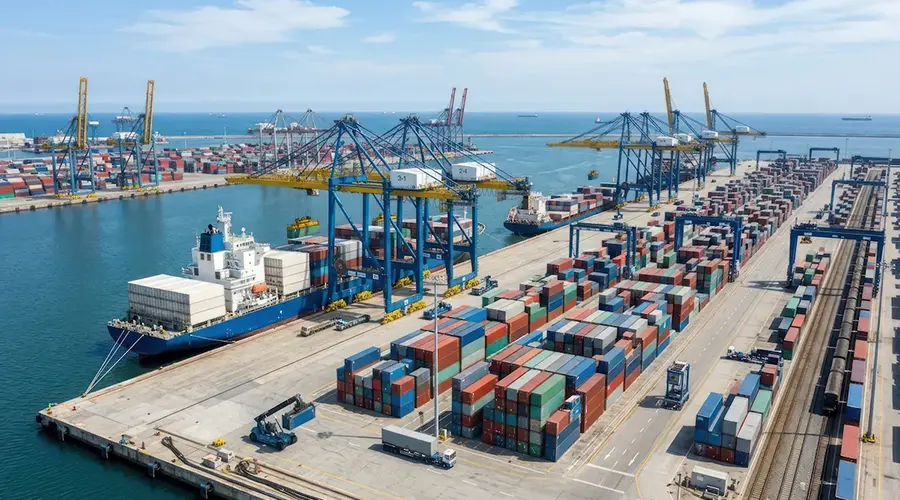
The 1960s brought scale and specialization. More functions/characteristics have been added to the ordinary container, such as insulation and foldability, etc.In 1960,Milan's BIC Exhibition showcased the industry's progress,and Hamburg's 1964 combined-traffic exhibition linked road, rail and sea.At this point, the container industry has achieved significant development.
As time goes by and technology becomes more mature,the development of containers came the turning point. Sea-Land launched a transatlantic container service in 1966, connecting the United States and Europe. In 1968, ISO 668 standardized the dimensions and ratings of Series 1 freight containers, making ships, trucks and trains compatible worldwide. By 1970, dedicated terminals like Teesport's Bell Lijn were cutting handling times and speeding vessel turnaround.
Mega ships followed. CMA CGM Marco Polo entered service in 2012 with 16,020 TEU; In 2013, the Maersk Triple-E class vessels were launched, with a capacity of approximately 18,270 standard containers. In the same year, the International Container Bureau (BIC) awarded the first BIC Industry Award. Today, the new generation of container ships have a capacity exceeding 24,000 standard containers.
With the development of the times, various types of containers have been designed and produced for different industries and transportation categories, such as open-top containers, half-height containers, reefer containers, flat rack containers, office containers, etc. The user demands are gradually becoming more specific, and the customization capabilities of factories are gradually improving. In the not-too-distant future, the container industry will move towards an intelligent direction, complemented by intelligent terminals, real-time cargo tracking systems, and environmentally friendly containers, providing more assistance for international transportation and storage.
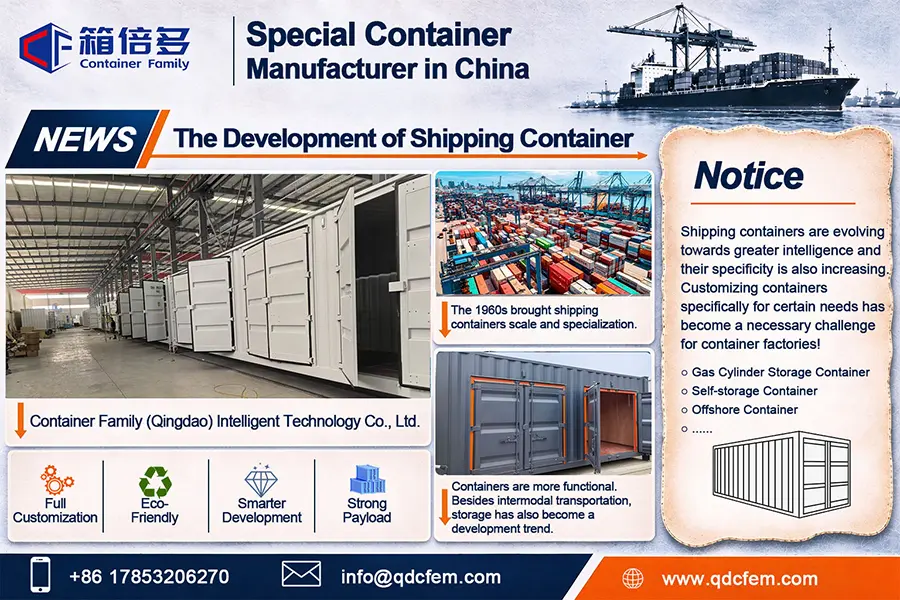
Container Family will continue to provide you with high-quality containers, especially special containers. We can fully customize them according to your requirements and propose targeted solutions. We are committed to achieving greater success and further development in the container industry. This journey continues. If you have any needs, please feel free to contact us at any time. We look forward to cooperating with you!
Send Inquiry



X
We use cookies to offer you a better browsing experience, analyze site traffic and personalize content. By using this site, you agree to our use of cookies.
Privacy Policy